Cold Calling is Dead. Cold Email is Dead. LinkedIn is Dead. Here's What's Killing Your Pipeline — And the One Channel That Can Save It.
Your SDRs are burning through lists. Your sequences are getting ignored. Your LinkedIn posts are being liked by people who will never buy from you. And somewhere in your CRM, there's a pipeline report that looks confident on paper and feels catastrophic in reality. You're not doing it wrong. The channels are just broken. It's time to bury them properly — and then talk about the one sales channel that actually deserves your attention in 2026.
Cold Calling is Dead
I know. You've heard this before. And every time someone says it, some red-faced sales director stands up at a conference and says "cold calling works if you do it right." With respect: no. The numbers are damning. The average B2B cold call connects with a decision-maker less than 2% of the time. Voicemail pick-up rates have collapsed. Mobile numbers are increasingly guarded. And the buyers who do pick up? They've developed a sixth sense for cold calls that triggers a reflexive "not interested" before you've finished your opener. The logic was always shaky: take a list of people who've shown zero interest in your product, interrupt their day, and attempt to compress a complex B2B buying decision into 90 seconds. It was never a good idea. It just used to work by sheer volume, because the bar was low and attention was cheap. That era is over.
Cold Email is Dead
Cold email held on longer. And to be fair, it had a decent run. But look at your inbox right now. Count the cold emails. Every one of them is from someone who scraped your details off LinkedIn, ran them through Apollo or ZoomInfo, and hit send on a sequence. The personalisation is fake. The "quick question" subject line isn't a question. And the P.S. line pretending to reference something specific about your company was written by an AI that barely glanced at your About page. Open rates are falling. Reply rates are falling. Deliverability is falling. Gmail and Outlook are getting aggressive with spam filtering. Legislation like GDPR and CAN-SPAM is tightening. Entire domains are being blacklisted. And the buyers who might once have replied with genuine curiosity have now been cold-emailed so many times that their delete reflex is essentially Pavlovian. The channel isn't just crowded. It's exhausted. The cruel irony? Every new tool that promises to make cold email easier — the AI personalisation layers, the multi-step sequence builders, the intent data enrichments — just accelerates the race to the bottom. Everyone gets the same tools. Everyone uses them the same way. The noise gets louder, the signal-to-noise ratio collapses, and your carefully crafted email joins the thousand others rotting in the Promotions tab.
LinkedIn is Dead (As a Sales Channel, Anyway)
LinkedIn has a content problem and a DM problem, and they feed each other perfectly. The content problem: the algorithm rewards "I almost quit and here's what I learned" posts over substantive professional insight. So everyone posts those. The feed has become a carousel of manufactured nonsense, motivational quotes, and carousel posts that somehow always have 47 slides. Real buyers aren't converting off LinkedIn posts — they're scrolling, double-tapping, and moving on. The DM problem: LinkedIn InMail and connection-request cold outreach are now so ubiquitous that anyone with a remotely senior title receives five to fifteen messages per day. The templates are obvious. The "I came across your profile and was really impressed" opener fools nobody. And the buyers who might have engaged two years ago have long since stopped accepting connection requests from people they don't recognise. LinkedIn is a great platform for brand awareness. It is a genuinely terrible place to close pipeline in 2026. The conversion rates are there to prove it.
So What's Actually Working?
Here's the question that should be sitting uncomfortably in your mind right now: if cold calling, cold email, and LinkedIn are all degraded channels — where does pipeline come from? The answer has been hiding in plain sight. It's your website. Right now, while you're reading this, companies are visiting your website. Real companies. Companies with real budgets, real problems, and real intent. They're reading your case studies, pricing pages, and product features. They're comparing you to competitors. Some of them are thirty seconds away from submitting a form. And then they leave. Anonymously. Forever. The average B2B website converts less than 3% of visitors into leads. That means 97% of the people who came to you — people who were interested enough to find you and spend time with you — vanish without a trace. You spend thousands on ads, SEO, and content to get them there. And then you let them walk out the door. This is the single biggest untapped opportunity in B2B sales.
Web Visitor Deanonymisation: The Channel Nobody Is Talking About
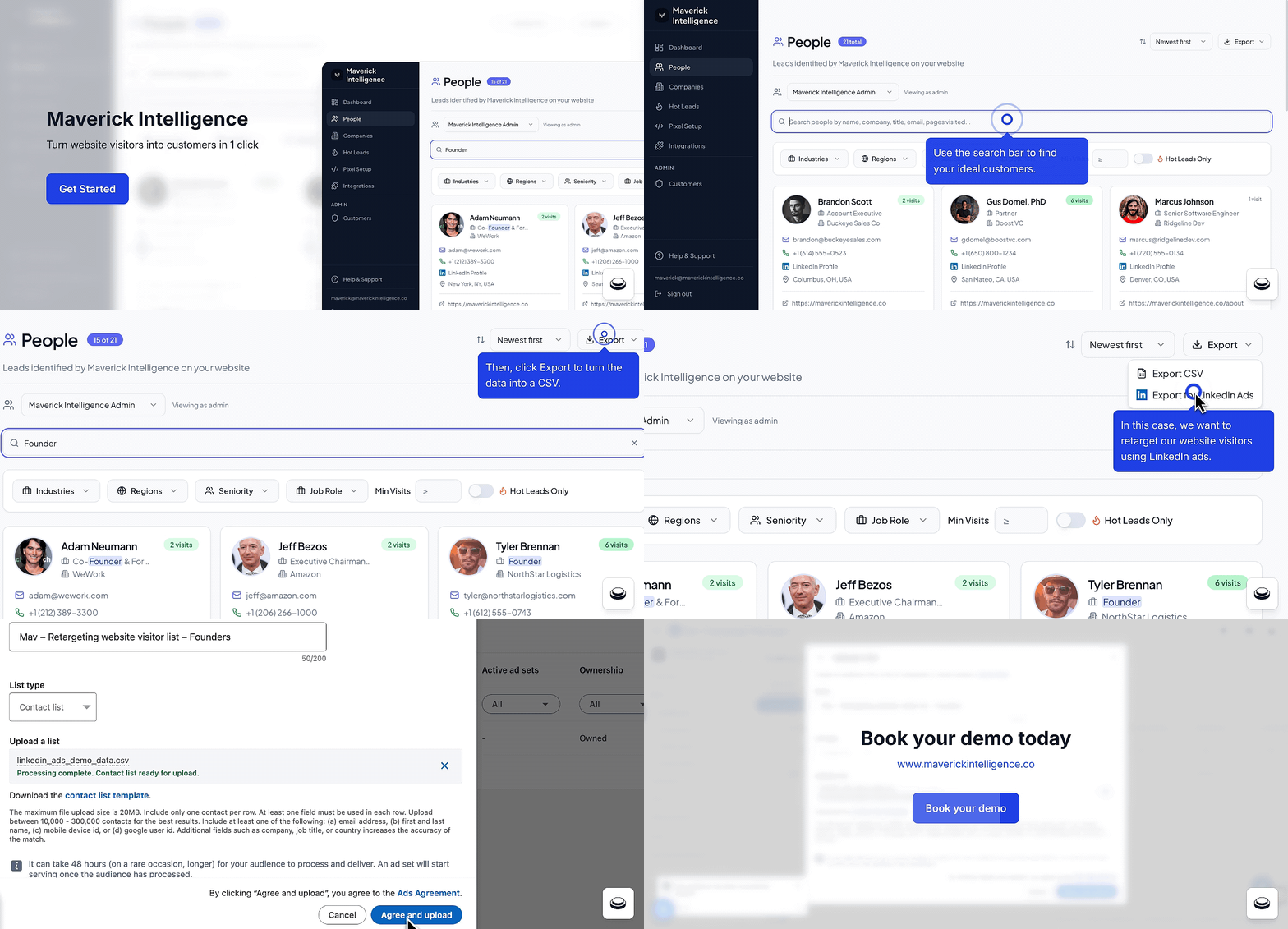
Web visitor deanonymisation is the process of identifying the companies — and in many cases, the specific individuals — behind anonymous website traffic. Using a combination of IP intelligence, identity graph matching, and first-party data enrichment, it's now possible to know who is on your website, what they're looking at, and when they're showing buying intent. Think about what that means. Instead of cold-calling someone who's never heard of you, you're calling someone who spent 14 minutes reading your pricing page this morning. Instead of sending a cold email into the void, you're reaching out to a VP who visited your "how it works" page three times this week. Instead of posting into the LinkedIn algorithm hoping the right person sees it, you're having a conversation with a buyer who is actively in-market right now. This isn't a warm lead. This is a hot lead.
Why This Is the Highest-Leverage Sales Channel Available
Every other sales channel starts from zero. Cold outbound begins with the assumption of zero interest and tries to manufacture it. That's expensive, time-consuming, and increasingly ineffective. Web visitor deanonymisation inverts the model entirely. Buying intent already exists. These visitors found you — through organic search, a referral, an ad, a piece of content. The intent signal is baked in. You're not creating interest; you're responding to it. The conversion rates are incomparable. When you reach out to someone who has already visited your website with a genuinely relevant, timely message, reply rates and conversion rates are multiples of what cold outbound achieves. You're continuing a conversation they already started. The economics make cold outbound look wild. Consider the cost-per-meeting of a cold email sequence versus the cost-per-meeting of engaging a high-intent website visitor. The latter wins every time, at every price point, in every market.
The Conclusion Your Sales Team Doesn't Want to Hear
Your outbound stack is not going to get better with another tool, another AI layer, or another sequence optimisation. The channels themselves are the problem. The buyers you want are already finding you. They're already on your website. They're already showing intent. And right now, you're letting them leave without knowing who they are. Web visitor deanonymisation is not a nice-to-have. For B2B sales teams serious about pipeline efficiency, it is rapidly becoming the most important channel in the stack. It is underutilised almost everywhere, which means early movers get an extraordinary advantage before it becomes as crowded as everything else. The funeral for cold outbound is long overdue. Your website has been trying to tell you something for years. It's time to listen.
Ready to identify your website visitors?
See exactly who's visiting your site and turn anonymous traffic into qualified pipeline.